
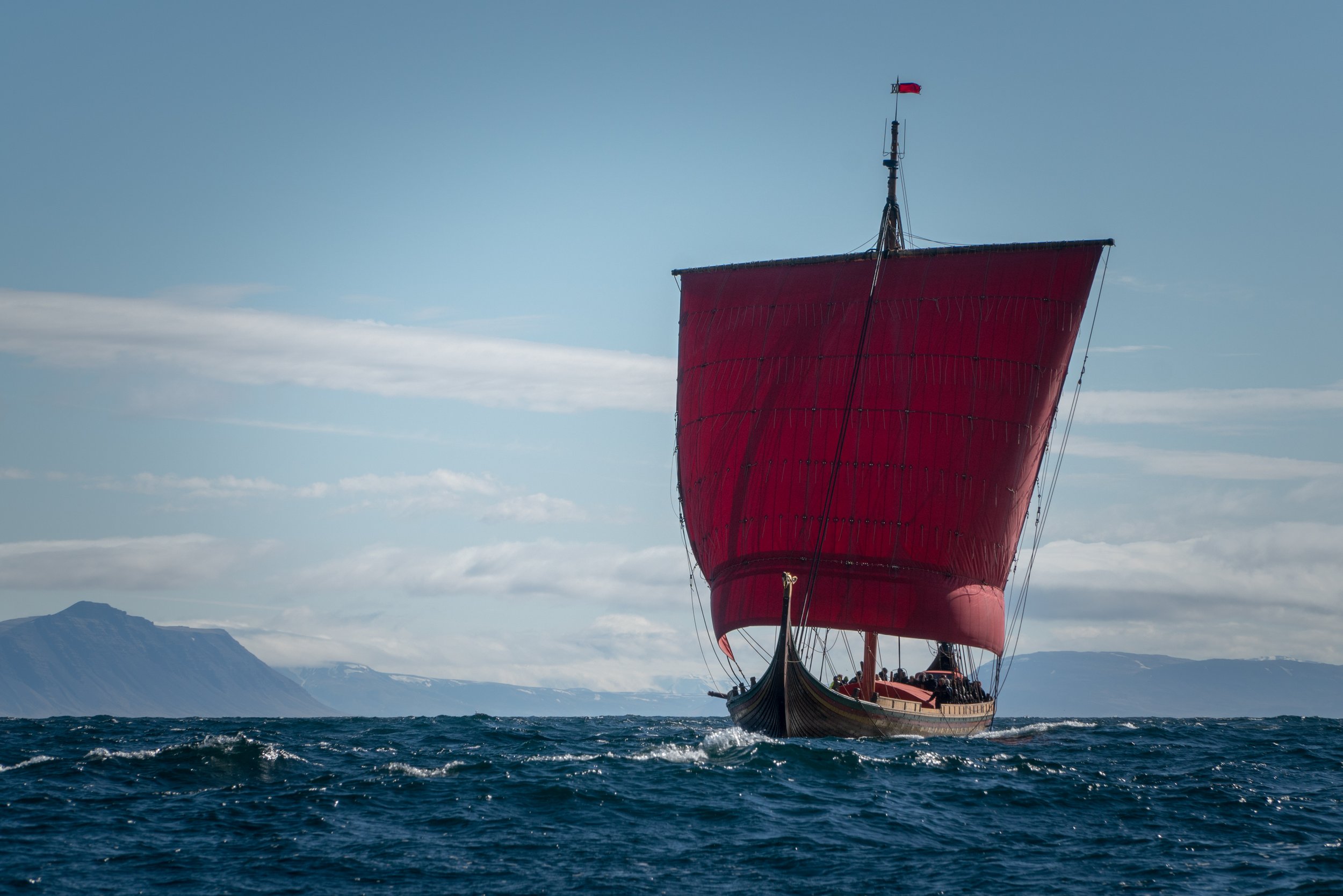
Built on knowledge. Driven by curiosity. Open to discovery.Research
It began with a question: What if?
What if we could better understand the Viking Age's extraordinary maritime capabilities by combining archaeology, living craftsmanship, and practical experimentation at sea?
Draken Harald Hårfagre was born of curiosity, a willingness to explore the unknown, and an ambition to better understand the Viking Age's technological achievements.
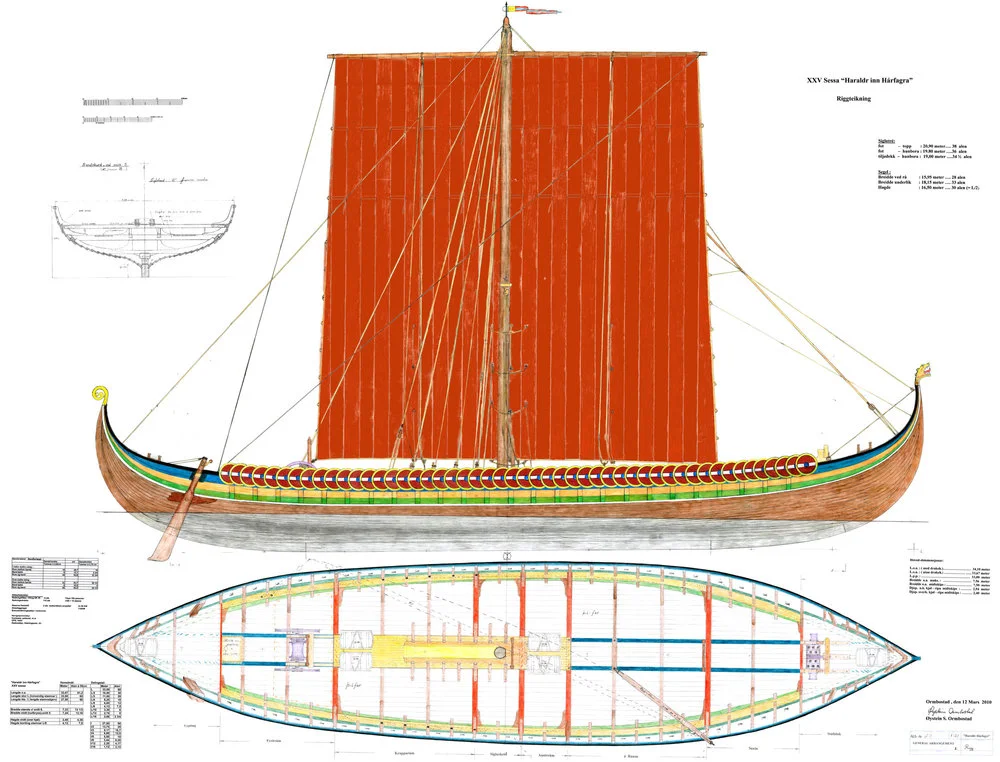
Rather than simply recreating a known archaeological find, the project set out to investigate what the great ocean-going ships described in the Norse sagas might have looked like, how they might have been constructed, and what they may have been capable of.
The result is not only a remarkable ship, but also a platform for exploration, experimental archaeology, and the pursuit of knowledge.
Great discoveries begin with curiosity, the courage to question what we know, and the willingness to explore what we do not.
The research behind DrakenOur understanding of Viking Age ships is based on a remarkable but incomplete archaeological record. Historical accounts describe ships of considerable size and sophistication, yet many questions about their construction, performance and use remain unanswered.
The development of Draken brought together several sources of knowledge:
Archaeological finds, including the Gokstad and Oseberg ships.
Historical descriptions found in the Norse sagas.
Living Norwegian boatbuilding traditions.
Traditional craftsmanship and practical maritime experience.
Experimental boatbuilding, model testing and sea trials.
Traditional boatbuilders, including Jon Bojer Godal and Gunnar Eldjarn, played important roles in bringing these different sources of knowledge together.
The ambition was not to reproduce a single historical vessel, but to explore a historically informed interpretation of a great Viking Age ship.
From hypothesis to experimentBefore construction of the full-scale ship began, three experimental boats were built to explore different design solutions.
Built at a scale of 1:3, the boats were named Urd, Verdandi and Skuld, after the three Norns of Norse mythology.
Through practical testing, the project investigated different hull forms and their behaviour on the water, including stability, rowing and sailing characteristics.
Verdandi demonstrated the most promising seaworthiness and became the basis for the further development of Draken Harald Hårfagre.
These experiments formed an important stage in the development of the ship, allowing ideas and assumptions to be explored in practice before construction began in Haugesund in 2010.
Experimental archaeology at full scaleBuilding a ship is one thing. Understanding how it behaves at sea is another.
Since her launch in 2012, Draken has provided a rare opportunity to explore the relationship between traditional ship construction, seamanship and the realities of ocean travel at full scale.
Her early sea trials, the voyage to Liverpool in 2014, and the North Atlantic expedition in 2016 have generated practical experience of sailing and operating a large, open, clinker-built wooden ship in demanding maritime environments.
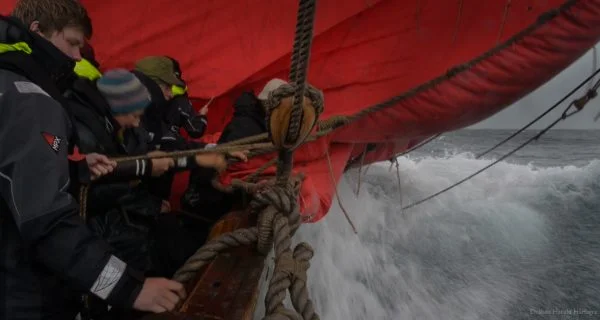
Life aboard Draken brings together questions of sail handling, stability, structural behavior, navigation, crew organization, and human endurance.
These experiences offer valuable observations and opportunities for further investigation.
They do not provide definitive answers about the past, but they can help us formulate better questions about it.
Preserving knowledge that cannot be found in booksMuch of the knowledge that made the Viking Age's maritime achievements possible was never written down.
People passed it from one generation to the next through observation, practice, and experience. Understanding timber, shaping a hull, handling a square sail, or reading the movements of the sea is part of a rich maritime heritage.
Living Nordic clinker boatbuilding traditions offer an important connection to this heritage.
Draken brings together boatbuilders, craftsmen and sailors whose practical experience represents a valuable source of knowledge.
Preserving, documenting, and sharing this knowledge matters not only for understanding the past, but also for ensuring future generations can learn from it.
A platform for future researchDraken offers an unusual opportunity to connect historical research with practical experience aboard a full-scale, operational ship.
Potential areas of future research include:
Viking Age ship design and construction methods.
Hydrodynamics, stability and seaworthiness.
Traditional rigging, square-sail technology and seamanship.
Historical navigation and maritime exploration.
Crew organization, human performance and life at sea.
The preservation and transmission of traditional maritime knowledge.
By bringing together archaeology, history, naval architecture, engineering, and traditional craftsmanship, Draken has the potential to contribute to a deeper, more interdisciplinary understanding of the maritime world of the Viking Age.
We believe that meaningful research must be open to different perspectives, independent investigation, and conclusions that may challenge existing assumptions, including our own.
Publications & resources Books, articles, photographs, film, and personal accounts from those involved document the construction and development of Draken Harald Hårfagre.
Selected publications include:
Draken Harald Hårfagre: Verdens største vikingskip
Arne-Terje Sæther and Gunnar Eldjarn, 2015.
A detailed account of Draken's construction, documenting traditional boatbuilding techniques, craftsmanship, and the ship's development.
SBN: 9788299732819
View publication
Draken Harald Hårfagre
Frans-Arne Stylegar, Vikingfylket Rogaland, 2022.
An archaeological and historical perspective on the development of Draken, traditional boatbuilding knowledge and the experimental vessels that preceded her construction.
Read publication
We recognize the importance of making historical documentation, practical experience, and research findings more accessible to researchers and others interested in Viking Age maritime technology.
Curiosity is where discovery beginsDraken was built because someone dared to ask: What if?
More than a decade after her launch, the questions remain unanswered.
We welcome dialogue with researchers, universities, museums, traditional boatbuilders, and other institutions interested in exploring Viking Age maritime knowledge, technology, and capabilities.
Together, we can preserve knowledge, challenge assumptions, inspire curiosity and open new possibilities for discovery.
Explore moreTo learn more about the wider purpose behind the project, visit Mission & Story. To explore where Draken appears on screen, visit Film & Television.